
Image: ESA
TROPOMI monitors trace gases and aerosols relevant for air quality and climate.
Launched in October 2017 aboard the European Copernicus Sentinel-5 Precursor (S5P) satellite, TROPOMI (Tropospheric Monitoring Instrument) is a cutting-edge sensor that provides the high-resolution data essential for understanding atmospheric processes and environmental changes. By monitoring air quality, tracking climate trends, and protecting the ozone layer, it serves as a global cornerstone for advancing both environmental science and policy.
Who uses TROPOMI data?
The users of the TROPOMI data include scientists, researchers, and environmental agencies worldwide. A key user of our data is the Copernicus Atmosphere Monitoring Service (CAMS), which utilizes the data for atmospheric composition forecasting and reanalysis. Other examples of applications using TROPOMI data are the UN methane emissions alert and response system (MARS), the Support to Aviation Control Service (SACS) and UV index forecasts.

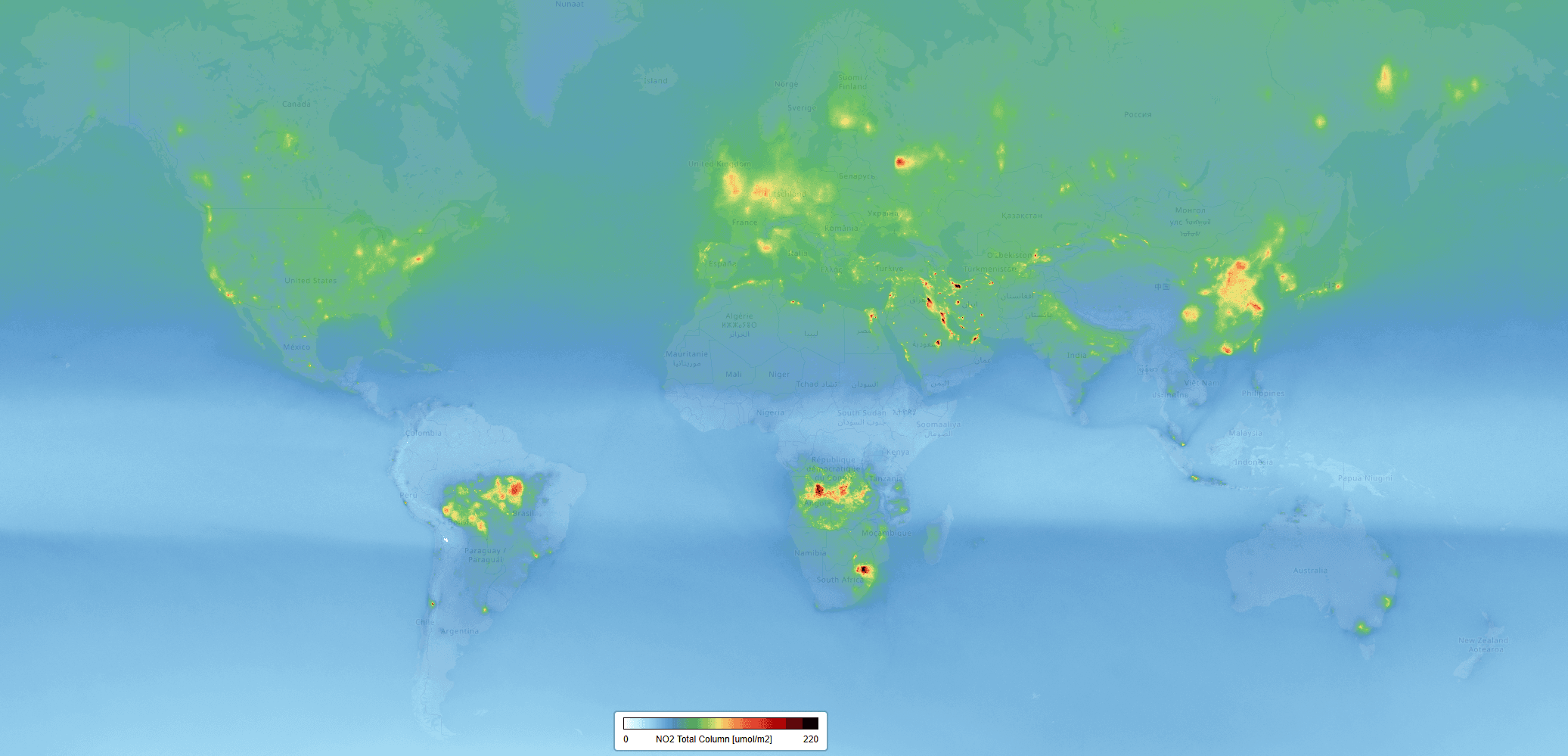
NO2 atmospheric column
Download
How does TROPOMI work?
TROPOMI is a high-precision imaging spectrometer that maps the atmosphere by measuring sunlight reflected and radiated from Earth across ultraviolet, visible, near-infrared, and shortwave infrared spectral bands. By scanning the entire planet daily, it captures data with a resolution of 3.5 x 5.5 km for most data products, and 7 x 5.5 km for shortwave infrared data products, allowing us to pinpoint the concentrations of various atmospheric gases with unprecedented accuracy.

Global Ozone (Sept 2025)
Download
Who developed TROPOMI?
The TROPOMI instrument was commissioned by the Netherlands Space Agency (NLSA) and the European Space Agency (ESA), and was designed and built by Airbus Netherlands, TNO, and SRON. As a core component of the European Copernicus programme, the Sentinel-5P mission is managed by ESA, while its data products are developed and maintained by the Atmospheric Mission Performance Cluster (ATM-MPC) and the Dutch national space programme, and is carried out by the following organizations:
- Royal Netherlands Meteorological Institute (KNMI), consortium lead
- Royal Belgian Institute for Space Aeronomy (BIRA-IASB)
- German Aerospace Center (DLR)
- Institute for Environmental Physics, University of Bremen (IUP-Bremen)
- Max Planck Institute for Chemistry (MPIC)
- Norwegian Institute for Air Research (NILU)
- Science & Technology (S[&]T)
- Space Research Organisation Netherlands (SRON)
- Aristotle University of Thessaloniki (AUTh)
Image: © KNMI, ESA, ATM-MPC